
The first Seabrook Armoured Cars was delivered on 5th Febraury of 1915 by
the Portholme Aerodrome Company, of Huntingdon, Cambridgeshire, U.K.


The Plattsburg Manual. A Handbook for Military Training, 1917:
The Plattsburg Manual. A Handbook for Military Training, 1917:
NOTE
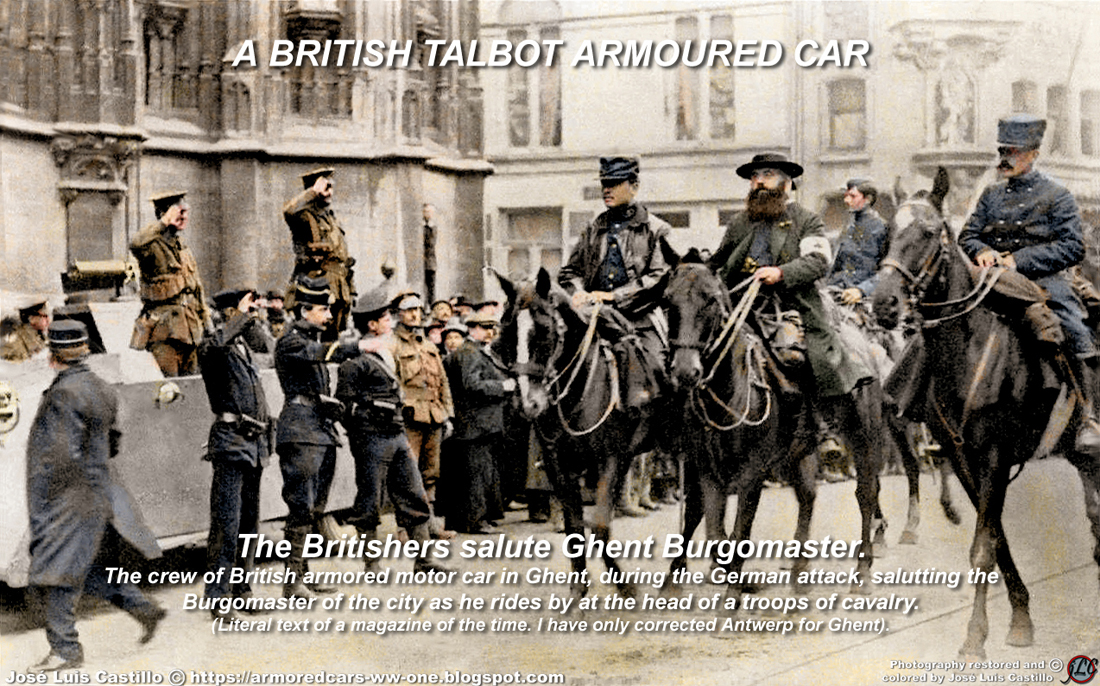
The building that is behind the armored car is part of four other buildings from different periods, and that together, united, make up the Ghent City Hall, forming an unusual block that some architect has defined as "a schizophrenic building", although Actually, this architectural complex does not lack, extreme beauty in each of its phases.
xxxxxxxxxxxxxxxxxxxxxxxx
La
tripulación de un coche blindado
británico Talbot saluda al alcalde de Gantes, Emile Braun, presidiendo un desfile patriótico, en el que
también intervinieron coches blindados belgas Minerva, pocos días antes de ser
ocupada la ciudad (12 de octubre de 1914) por los alemanes.
NOTA
El edificio que está a la espalda del coche blindado forma parte de otros cuatro edificios de diferentes épocas, y que juntos, unidos, constituyen el Ayuntamiento de Gante, formando una insólita manzana que algún arquitecto a definido como "un edificio esquizofrénico", aunque realmente, este conjunto arquitectónico no carezca en absoluto, de extrema belleza en cada una de sus fases.


Japanese Austin Armoured Car Mk. IV. Vladivostok, Siberia, Rusia 1920.
Confusingly called also, Model 1918 or 1918 Pattern, when in fact it was manufactured in 1917. Six examples were sold to Japan by the United Kingdom. Undoubtedly the best of the four versions manufactured by Austin for the Russian Government. The political situation in Russia in 1917, was the reason to seize the shipment of the 60 models manufactured in 1917, to the Russian government. One of these models was sent to the Belgian government to evaluate the possibility of acquiring more copies. After the end of the war, the Belgians returned it to the British along with three surviving Lanchesters of the war, out of the four Lanchesters previously ceded in 1916 by the British. The four armored cars participated in Bond sales campaigns in the UK, later two Lanchesters were ceded to the Italians, who used them in the desert until their consummation in 1926.
***
There is a photo in this blog that reveals why an Austin Type IV appears next to the three Belgian Lanchesters returned to the British. The reason: because it was part of the armored cars ceded by the British to the Belgians and later returned, as has been said previously:
Tuesday, July 24, 2012
Three ex-Belgian Lanchester and an Austin Mk. IV Armoured Cars, exposed in a square of Birmingham (probably after the war), during the Victory Loan Campaign.
https://armoredcars-ww-one.blogspot.com/2012/07/three-ex-belgian-lanchester-and-austin.html
XXXXXXXXXXXXXXXXX
Coche Blindado japonés Austin Tipo IV. Vladivostok, Siberia, Rusia 1920.
Confusamente denominado también, Modelo 1918, cuando en realidad fue fabricado en 1917. Seis ejemplares fueron vendidos a Japón por el Reino Unido. Sin lugar a dudas la mejor de las cuatro versiones fabricadas por Austin para el Gobierno ruso. La situación política en Rusia en 1917, fue el motivo para embargar el envió de los 60 modelos fabricados en 1917, al gobierno ruso. Uno de estos modelos fue enviado al gobierno belga para que evaluara la posibilidad de adquirir más ejemplares. Después del final de la guerra, los belgas lo devolvieron a los británicos junto con tres Lanchester sobrevivientes a la guerra, de los cuatro Lanchester cedidos anteriormente en 1916 por los británicos. Los cuatro coches blindados participaron en UK en campañas de venta de Bonos, posteriormente dos Lanchester fueron cedidos a los italianos, quienes los utilizaron en el desierto hasta su consumación en 1926.
***
Hay una foto en este blog que desvela el porque aparece un Austin Tipo IV junto a los tres Lanchester belgas de vueltos a los británicos. La razón: porque formaba parte de los coches blindados cedidos por los británicos a los belgas y posteriormente devueltos, como ha quedado dicho anteriormente:
martes, 24 de julio de 2012
Tres ex Coches Blindados Lanchester belgas y un Austin Mk. IV, expuesto en una plaza de Birmingham (probablemente después de la guerra), durante la Campaña de préstamo de la Victoria (Victory Loan Campaign).
https://armoredcars-ww-one.blogspot.com/2012/07/three-ex-belgian-lanchester-and-austin.html


View of the six Talbot (Clement-Talbot) Type-3 M1914 or 'Modified Dunkirk Type' Armored Cars. This is the notable modification and improvement, carried out in Dunkirk at the "Forges et Chantiers de France", on six Talbot Type-1 or Type Standard M1914 (*) Armored Cars. The work was carried out under the supervision of R.N.A.S. Lieutenant F. R. Samson, who had assisted in its design.
Of these new Talbot (Clement-Talbot) Type-3, it is worth highlighting the existence of two types of clearly differentiated sub-models: two of the long type and four of the short type.
(*)- First Admiralty pattern Talbot Armoured Car.
Differential characteristics of both sub-models:
1st- Talbot Type-3. Long chassis.
These two models correspond to the first two on the left of the photograph, No. 1 and 2.
The rear of both vehicles was noticeably elongated and slightly sloped.
Also the armored superstructure was more elongated in these two models.
Also the two models were visibly taller than the four short ones.
The driver's embrasures were large and nearly square.
Both 'long' models each carried two machine guns without shields.
2nd- Talbot Type-3. Short chassis.
These models correspond to the remaining four: Nº 3, 4, 5 and 6.
In these four models, the rear ended in a steeper and shorter way.
The armored superstructure was shorter on all four models.
The driver's embrasures, on these four models, were narrow and elongated.
These four 'short' models were each equipped with a single shielded machine gun.
xxxxxxxxxxxxxxxxxxxxxxxxxxxxxx
Los seis Coches Blindados Talbot Tipo-3, después de su modificación en las "Forges et Chantiers de France". Dunkerque, 5-XI-1914.
Vista de los seis Coches Blindados Talbot (Clement-Talbot) Tipo-3 M1914 o Tipo Dunkerque Modificado. Se trata de la notable modificación y mejora, realizada en Dunkerque en las "Forges et Chantiers de France", sobre seis Coches Blindados Talbot Tipo-1 o Tipo Estándar M1914 (*). El trabajo se realizó bajo la supervisión del teniente R.N.A.S., F. R. Samson, que había ayudado a su diseño.
De estos nuevos Talbot (Clement-Talbot) Tipo-3, hay que destacar la existencia de dos tipos de sub-modelos claramente diferenciados: dos de tipo largo y cuatro de tipo corto.
(*)- Primer modelo del Almirantazgo del Coche Blindado Talbot.
Características diferenciales de ambos sub-modelos.
1º- Talbot Tipo-3. Chasis largo.
Estos dos modelos corresponden a los dos primeros a la izquierda de la fotografía, N.º 1 y 2.
La parte trasera de ambos vehículos era notablemente alargada y ligeramente inclinada.
También la superestructura blindada era más alargada en estos dos modelos.
También los dos modelos eran visiblemente más altos que los cuatro cortos.
Las aspilleras del conductor eran grandes y casi cuadradas.
Ambos modelos 'largos' portaban, cada uno, dos ametralladoras sin escudos.
2º- Talbot Tipo-3. Chasis corto.
Estos modelos corresponden a los cuatro restantes: N.º 3, 4, 5 y 6.
En estos cuatro modelos, la parte trasera acababa de forma más inclinada y corta.
La superestructura blindada era más corta en estos cuatro modelos.
Las aspilleras del conductor, en estos cuatro modelos, eran estrechas y alargadas.
Estos cuatro modelos 'cortos' estaban equipados, cada uno, con una única ametralladora dotada de escudo.

A self-propelled anti-aircraft battery, consisting of four Pierce-Arrow A-A Armored Cars, transported on a pontoon-crane to be landed at a French port, probably Calais, in mid to late April 1915.
For more information about this Anti-Aircraft Armored Car, visit:
http://www.landships.info/landships/car_articles.html?load=car_articles/Pierce_Arrow_AA_Lorry.html
https://tanks-encyclopedia.com/ww1/gb/Pierce-Arrow.php
https://en.wikipedia.org/wiki/Pierce-Arrow_armoured_AA_lorry
**********************
Desembarco en Francia de los primeros Vehículos Blindados Antiaéreos Pierce-Arrow en abril de 1915.
Una batería antiaérea autopropulsada, compuesta de cuatro Pierce-Arrow A-A Armoured Cars, transportada sobre un pontón-grúa para ser desembarcada en un puerto francés, probablemente el de Calais, a mediados o finales de abril de 1915.
Para ampliar la información sobre éste Coche Blindado Antiaéreo, visita:
http://www.landships.info/landships/car_articles.html?load=car_articles/Pierce_Arrow_AA_Lorry.html
https://tanks-encyclopedia.com/ww1/gb/Pierce-Arrow.php
https://en.wikipedia.org/wiki/Pierce-Arrow_armoured_AA_lorry

