Warning: The originals photos, texts, films, music, etc ... of the period previous to 1921 year -see the Act of the US Congress about it - have no copyright and belong to the public domain. However, those same pictures, I process this blog, when I restore and paint the pictures, then the right of modification is produced, ie that are protected by full copyright law, in this case mine. Of course there are many more laws in the world, declared in the public domain photographs (which is the topic at hand), in very later dates to the aforementioned (Example: WWII, Korea, etc ...) .

Monday, February 27, 2023

"Le Grand Album des Automitrailleuses de la Victoire" by François Vauvillier. A new book on the history of French armored cars of the Great War!


"Le Grand Album des Automitrailleuses de la Victoire" by François Vauvillier.

A few weeks ago I began to prepare a text with the purpose of presenting in this blog the definitive and great work of my esteemed colleague François Vauvillier on the French armored cars "Automitrailleuses" of the Great War.

The text was practically finished, but despite knowing part of his work through the countless emails exchanged over several months, I decided to wait until I had his book in my hands. It came to me earlier this week, and now I can describe it with real objectivity. 

The work in question, recently appeared and that some of you may already know is: "Le Grand Album des Automitrailleuses de la Victoire" published by the French publisher Histoire & Collections, and edited with the special personal imprint that has always characterized the books of François Vauvillier. . 

This is a fundamental work, which is of great importance for describing and, definitively fixing, the historical progression, step by step, of French motorized vehicles on wheels, armored or not, from the origins to the end of the Great War. 

Each one of the 10 successive and chronological chapters of the book, affects the essential historical aspects of each period, accompanying the texts with exhaustive graphic documentation and complementing, illustrations and texts, with endless explanatory notes of erudite reflections and bibliographical citations. 

François Vauvillier is without any doubt the greatest specialist in French combat vehicles of the Great War.

This combined with his great art and mastery of the printed edition, make his book a magisterial, definitive and highly recommended work for all scholars and fans of the motorized history of the Great War, in which France had, also in this field, an outstanding role.

Bibliographic record

Vauvillier, François

"Le Grand Album des Automitrailleuses de la Victoire"

Histoire et Collections, Paris, 2023, 1st Edition.

In Folio major (32 x 24 cm), 170 pages. Printed hardcovers. Sewn binding. Coated paper. 

400 illustrations and photographs, 70 of them in color.

Profiles and other color illustrations by Jose Luis Castillo, Laurent Lecocq and Éric Schwartz.

Work written in French.

ISBN: 979-10380-1314-8

P.V.P.- €39.95


Link to the Histoire & Collections publishing house:

https://histoireetcollections.com/fr/home/5106-le-grand-album-des-automitrailleuses-de-la-victoire.html 


Table des matières

0-Introduction

1-Premières en France

2-En service en Afrique

3-Flèches de tout bois

4-Des voitures à la marge

5-Organiser les groupes

6-Améliorer le blindaje

7-Unifier le matériel?

8-Les groupes de 47

9-Sur les fronts lointains

10-La voiture idéale ?

Table synoptique des groupes 1914-1916 (marine)

Table synoptique des groupes 1916-1918 (cavalerie)

Remerciements


xxxxxxxxxxxxxxxxx-ESPAÑOL-xxxxxxxxxxxxxxxxx


"Le Grand Album des Automitrailleuses de la Victoire" de François Vauvillier.

Hace unas semanas comencé a preparar un texto con la finalidad de presentar en este blog, la definitiva y gran obra de mi estimado colega François Vauvillier sobre los coches blindados franceses "Autoametralladoras" de la Gran Guerra.

Tenía el texto prácticamente acabado, pero a pesar de conocer parte de su obra por los innumerables correos intercambiados durante varios meses, decidí esperar hasta tener en mis manos su libro. Me llegó a principios de esta semana, y ahora puedo describirlo con verdadera objetividad.

La obra en cuestión, recién aparecida y que algunos quizás ya conocéis es: "Le Grand Album des Automitrailleuses de la Victoire" publicado por la editorial francesa Histoire & Collections, y editado con la especial impronta personal que siempre a caracterizado los libros de François Vauvillier.

Se trata de una obra fundamental, que reviste una gran importancia por describir y, fijar definitivamente, la progresión histórica, paso a paso, de los vehículos franceses motorizados sobre ruedas, blindados o no, desde los orígenes hasta el final de la Gran Guerra.

Cada uno de los 10 sucesivos y cronológicos capítulos del libro, incide en los aspectos históricos esenciales de cada período, acompañando los textos con una exhaustiva documentación gráfica y complementando, ilustraciones y textos, con un sinfín de notas aclaratorias de eruditas reflexiones y citas bibliográficas.

François Vauvillier es sin ningún tipo de dudas el mayor especialista de los vehículos de combate franceses de la Gran Guerra.

Esto combinado con su gran arte y dominio de la edición impresa, hacen de su libro una obra magistral, definitiva y altamente recomendable para todos los estudiosos y aficionados a la historia motorizada de la Gran Guerra, en la que Francia tuvo, también en este ámbito, un papel destacadísimo.

Ficha Bibliográfica

Vauvillier, François

"Le Grand Album des Automitrailleuses de la Victoire"

Histoire et Collections, París, 2023, 1ª Edición.

En Folio mayor (32 x 24 cm), 170 páginas. Papel couché. Cartoné impreso religado. 400 ilustraciones y fotografías, 70 de ellas en color.

Perfiles y otras ilustraciones en color de Jose Luis Castillo, Laurent Lecocq y Éric Schwartz.

Obra escrita en francés.

ISBN: 979-10380-1314-8

P.V.P.- 39,95 €


Enlace a la editorial Histoire & Collections : 

https://histoireetcollections.com/fr/home/5106-le-grand-album-des-automitrailleuses-de-la-victoire.html


Table des matières

0-Introduction

1-Premières en France

2-En service en Afrique

3-Flèches de tout bois

4-Des voitures à la marge

5-Organiser les groupes

6-Améliorer le blindaje

7-Unifier le matériel?

8-Les groupes de 47

9-Sur les fronts lointains

10-La voiture idéale ?

Table synoptique des groupes 1914-1916 (marine)

Table synoptique des groupes 1916-1918 (cavalerie)

Remerciements


Reserved for new post.


Two RNAS Seabrook Armoured Cars, Huntingdon, Cambridgeshire, U.K., 1915.

 The first Seabrook Armoured Cars was delivered on 5th Febraury of 1915 by 
the Portholme Aerodrome Company, of Huntingdon, Cambridgeshire, U.K.

Friday, February 17, 2023

US Parade- 1-ton White Reconnaissance M.G. Cars M1918.


 US Parade: four 1-ton White Reconnaissance MG Cars M1918, armed with Browning Machine Guns M1917.

xxxxxxxxxxxxx

Desfile de EE. UU.: cuatro autos MG de reconocimiento White M1918 de 1 tonelada, armados con ametralladoras Browning M1917.

French armored car "Auto-Mitrailleuse" Renault, ready for anti-aircraft fire, 1915.


 French armored car "Auto-Mitrailleuse" Renault, ready for anti-aircraft fire, 1915.

Auto-Mitrailleuse Renault M1914, with the flat rectangular shield of the machine gun, adapted for anti-aircraft shooting. This new task assigned to the French armored cars, as was the anti-aircraft defense close to the front, it began to be applied in the first part of the year 1915, when the threat of a mobile front was annulled by the appearance of the entrenched front.


xxxxxxxxxxxxxxxxx


Coche blindado francés "Auto-Mitrailleuse" Renault, dispuesto para el fuego antiaéreo, 1915.

Auto-Mitrailleuse Renault M1914, con el escudo rectangular plano de la ametralladora, 
adaptado para el tiro antiaéreo. Esta nueva tarea asignada a los coches blindados franceses, 
como lo fue la defensa antiaérea proxima al frente, comenzo a aplicarse en la primera parte del año 
1915, cuando la amenaza de un frente móvil fue anulada por la aparición del frente atrincherado.

British RNAS Delaunay-Belleville Armoured Car at Dunkirk in 1914. Original configuration.


RNAS Delaunay-Belleville Armoured Car M1914. Original configuration.

See also another similar model, but improved, in North Kensington (London) in the headquarters of the "Royal Naval Armored Car Division", as part of the 14th Squadron.

Wednesday, June 16, 2021 
British Delaunay-Belleville Armoured Car M1915 (Royal Naval Armoured Car Division)


xxxxxxxxxxxxxxxx


Coche Blindado Delaunay-Belleville de la RNAS M1914. Configuración original.

 Ver también otro modelo similar, pero mejorado, en North Kensington (Londres) en los cuarteles de la "Royal Naval Armoured Car Division" (División de automóviles blindados de la Marina Real) formando parte del 14.º Escuadrón.

Miércoles, 16 de junio de 2021
British Delaunay-Belleville Armoured Car M1915 (Royal Naval Armoured Car Division)


Thursday, February 16, 2023

Italian Bianchi Armored Car captured by the Austro-Hungarian assault troops, 1917.


 Italian Bianchi Armored Car captured by the Austro-Hungarian assault troops after the retreat from Caporetto in 1917. Possibly in Udine or its surroundings.

See the post:
Thursday, July 1, 2021
Italian Bianchi Armored Car M1913. Modified in 1915. Udine, Italy 1915. 


xxxxxxxxxxxx


Coche Blindado italiano Bianchi capturado por las tropas de asalto austro-húngaras después de la retirada de Caporetto en 1917. Posiblemente en Udine o sus alrededores.

Ver el post: 
Jueves, 1 de julio de 2021
Coche Blindado italiano Bianchi M1913. Modificado in 1915. Udine, Italia 1915.

US. Autocar (4x2) 2-ton, Machine Gun Car. Plattsburg, New York, Training Camp, ca. 1916-17.

US. Autocar (4x2) 2-ton, Machine Gun Car. 
Plattsburg, New York, Training Camp, ca. 1916-17. 

US. Autocar (4x2) 2-ton, Machine Gun Car. Plattsburg, New York Training Camp. Circa 1916-17.

Despite its great reliability, it was never taken into service by the US. Army, but yes by some states for their respective National Guards.

About half a thousand were purchased by Britain during the war. Most of them were sent to Africa and some others to France. They were also acquired by Canada, being some armored.

Attached a curious link about the Plattsburg training camp in New York.

The Plattsburg Manual. A Handbook for Military Training, 1917:

https://www.gutenberg.org/files/19552/19552-h/19552-h.htm


---------------------------


EE.UU. Autocar (4x2) 2 toneladas, Auto ametralladora. Campo de entrenamiento de Plattsburg, 
Nueva York. Circa 1916-17.

A pesar de su gran fiabilidad, nunca fue adoptado para el servicio por el US. Army, pero sí por algunos estados para su Guardia Nacional respectiva.

Cerca de medio millar fueron adquiridos por Gran Bretaña durante la guerra. La mayor parte de ellos fueron enviados a África y algunos otros a Francia. También los adquirió Canadá, siendo algunos blindados.

Adjunto un link curioso sobre el campo de entrenamiento de Plattsburg en New York.

The Plattsburg Manual. A Handbook for Military Training, 1917: 

 https://www.gutenberg.org/files/19552/19552-h/19552-h.htm


A Mexican Protos Armored Car. Mexico D.F., circa 1920.


 A Mexican Protos Armored Car. 

Mexico D.F., circa 1920.

Made in Mexico on a German Protos chassis.

Fabricado en México sobre un chasis alemán Protos.

Sunday, January 29, 2023

German Panzerauto Daimler M1915. Romania, November 1916.


 The German Panzerauto Daimler M1915 on the Romanian Front, in November 1916. It belonged to the "Panzerkraftwagen Maschinengewehr Abteilung I" (Pz.-Kw.-MG-Abt. 1.).

xxxxxxxxxxxxxxxxxxx

El Panzerauto alemán Daimler M1915 en el Frente Rumano, en noviembre de 1916. Pertenecía al "Panzerkraftwagen Maschinengewehr Abteilung I" (Pz.-Kw.-MG-Abt. 1.).


Belgian Pipe Armored Car. Antwerp 1914.


 See the post of Saturday, August 27, 2011:

Ver el post del sábado 27 de agosto de 2011:

Saturday, January 28, 2023

The art of confusion. The Pipe Armored Car affaire.


 The art of confusion. The Pipe Armored Car affaire.

XXXXXXXXXXXXXXXX


THE ORIGINAL GRAPHIC INFORMATION

LA INFORMACIÓN GRÁFICA ORIGINAL


The Illustrated London News. November 1914.


Fighting both the Germans and winter in 1914.


THE FALSE GRAPHICAL INFORMATION

LA INFORMACIÓN GRÁFICA FALSA

Automobiles, Blindées et motocyclettes, 1915.


Detail of the armored cars fraud, 1915.


For more information see the comments of this post, clicking here below.

Para más información ver los comentarios de este post, clicando aquí debajo.

Saturday, December 24, 2022

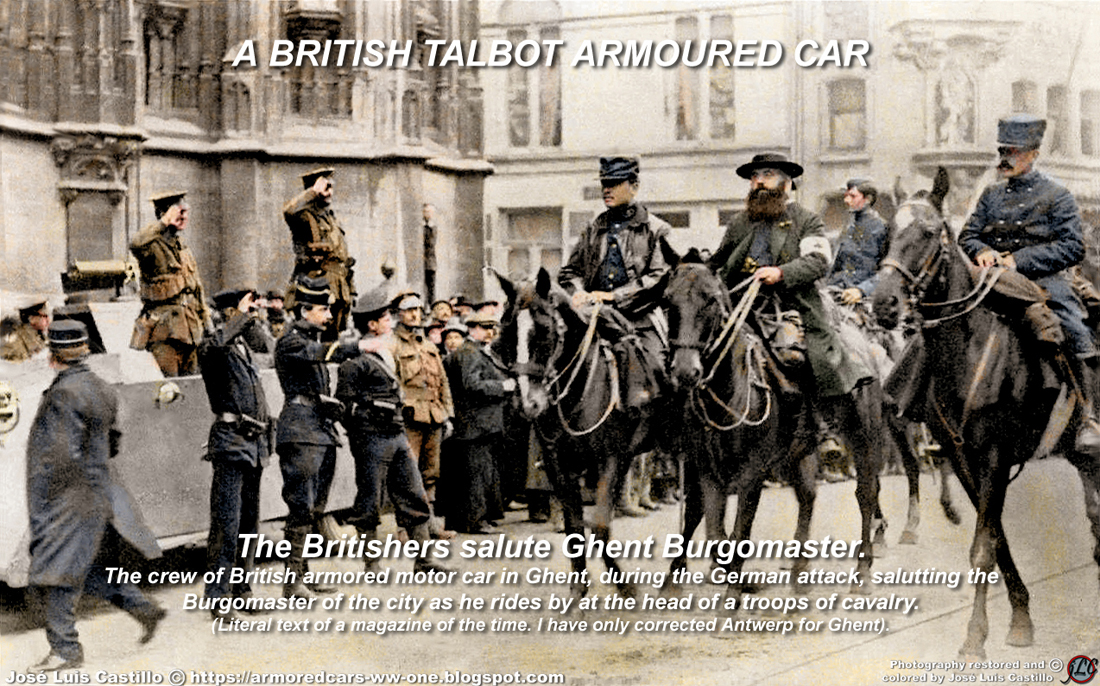
The crew of a British Talbot Armoured Car greets the Mayor of Ghent, Emile Braun. Belgium, October 1914.

 
The crew of a British Talbot Armoured Car greets the Mayor of Ghent, Emile Braun, presiding over a patriotic parade, in which Belgian Minerva Armoured Cars also took part, a few days before the city was occupied (October 12, 1914) by the Germans.

NOTE

The building that is behind the armored car is part of four other buildings from different periods, and that together, united, make up the Ghent City Hall, forming an unusual block that some architect has defined as "a schizophrenic building", although Actually, this architectural complex does not lack, extreme beauty in each of its phases.

xxxxxxxxxxxxxxxxxxxxxxxx

La tripulación de un coche blindado británico Talbot saluda al alcalde de Gantes, Emile Braun, presidiendo un desfile patriótico, en el que también intervinieron coches blindados belgas Minerva, pocos días antes de ser ocupada la ciudad (12 de octubre de 1914) por los alemanes.

NOTA

El edificio que está a la espalda del coche blindado forma parte de otros cuatro edificios de diferentes épocas, y que juntos, unidos, constituyen el Ayuntamiento de Gante, formando una insólita manzana que algún arquitecto a definido como "un edificio esquizofrénico", aunque realmente, este conjunto arquitectónico no carezca en absoluto, de extrema belleza en cada una de sus fases.

A rare version of the Talbot M1914 Type-3 Armoured Car. The prototype?


A rare version of the Talbot M1914 Type-3 Armoured Car. The prototype?

This is a rare version with the armoured superstructure cut from the Talbot Type-3 model. The rear part of it has been cut at a right angle, thus reducing the combat chamber and lightening the weight of the vehicle, which maintains the machine gun with its shield as in the standard Type-3 models. It could also be the prototype that later gave rise to the standard modification of the Type-3 (raised armoured superstructure). (See posts after this one, about Talbot Armoured Cars M1914).

xxxxxxxxxxxxxxx

Una rara versión del Coche Blindado Talbot M1914 Tipo-3  ¿El prototipo?.

Ésta es una rara versión con la superestructura blindada recortada del modelo Talbot Tipo-3. La parte trasera de la misma ha sido recortada en ángulo recto, reduciendo así la cámara de combate y aligerando de peso al vehículo, que mantiene la ametralladora con su escudo como en los modelos estándar Tipo-3. También podría tratarse del prototipo que posteriormente dio lugar a la modificación estándar del Tipo-3 (superestructura blindada sobre-elevada). (Ver posts posteriores a éste, sobre los Coches Blindados Talbot M1914). 

Wednesday, December 21, 2022

A German Ehrhardt M1917 Armored Car, awaiting repair.


A German Ehrhardt M1917 Armored Car, pending repair, in the courtyard of an army barracks.

xxxxxxx

Un Coche Blindado alemán Ehrhardt M1917, pendiente de reparación, en el patio de un cuartel del ejército.

The four Belgian Lanchester Armored Cars, on loan from the British, together in 1915.


 The four Belgian Lanchester Armored Cars, on loan from the British, together in 1915.

This is one of the few photographs where it is possible to see together, the only four Lanchester Armored Cars, ceded by the British to the Belgian army at the end of 1915.

In Bergues, in the Nord-Pas-de-Calais region, France, late 1915.

After many years, I have reviewed the post about the Belgian Lanchesters, edited on December 24, 2011:


xxxxxxxxxxxxxxxxx


Los cuatro Coches Blindados Lanchester belgas, cedidos por los británicos, juntos en 1915.

Esta es una de las pocas fotografías donde es posible observar juntos, los únicos cuatro Coches Blindados Lanchester, cedidos por los británicos al ejército belga a finales de 1915.

En Bergues, en la región Norte-Paso de Calais, Francia finales de 1915.

Después de muchos años, he revisado el post sobre los Lanchester belgas, editado el 24 de diciembre de 2011:

Tuesday, December 20, 2022

The 2nd Squadron of the 3rd Italian African Hunters Battalion, formed in the courtyard of the Berka Barracks. Benghazi, Libya 1922.


 The 2nd Squadron of the 3rd Italian African Hunters Battalion, formed in the courtyard 
of the Berka Barracks. Benghazi, Libya 1922.

Behind the first armored vehicle, a Lancia 1ZM M1918 rearmed with new machine guns(*), the two Lanchester ceded to Italy by the British in 1919, from Belgian war returns. Behind them 2 armored trucks with a shield, from those manufactured in Benghazi in 1915 for the “Sezione Automitragliatrci”. Next, a dozen vehicles, possibly armored and armed, probably on Fiat type 15 ter chassis. The last of the Lanchesters was decommissioned for service in 1926(**).

(*) The original armament has been replaced by 3 x Hotchkiss M1914 French anti-aircraft machine guns, Type MdlA. Note the large flash suppressor originally developed for the St. Étienne M1907 machine gun, attached to the muzzle of the 3 Hotchkiss M1914s. The two in the turret and the rear in the armored superstructure.

(**)According to data from the Italian General Staff:
Tactical use: The two machines served a long time (the last one, license plate 3468, was disbarred in 1926), and participated in numerous actions against the rebels. In 1923 they were part of the 2nd Squadron of the 3rd Cacciatori.


xxxxxxxxxxxxxxx


2º Escuadrón del 3º Batallón de Cazadores de África italiano. Formado en el patio del 
cuartel de Berka, Bengasi, Libia 1922.

Detrás del primer vehículo blindado, un Lancia 1ZM M1918 rearmado con nuevas ametralladoras(*), los dos Lanchester cedidos a Italia por los británicos en 1919, procedente de la devolución de guerra belga. Detrás de ellos 2 camiones blindados con escudo, procedentes de los fabricados en Bengasi en 1915 para la “Sezione Automitragliatrci”. A continuación, una docena de vehículos, posiblemente blindados y armados, probablemente sobre chasis tipo Fiat tipo 15 ter. El último de los Lanchester fue dado de baja para el servicio en 1926(**).

 (*) El armamento original ha sido sustituido por 3 x Ametralladoras francesa antiaéreas Hotchkiss M1914, Tipo MdlA. Nótese el gran apagallamas desarrollado originalmente para la ametralladora St. Étienne M1907, unido a la boca de las 3 Hotchkiss M1914. Las dos de la torreta y la trasera en la superestructura blindada.

(**) Según datos del EM italiano: 
Uso táctico: Las dos máquinas sirvieron durante mucho tiempo (la última, matrícula 3468, fue inhabilitada en 1926), y participaron en numerosas acciones contra los sublevados. En 1923 formaban parte del 2º Escuadrón del 3º Cacciatori.

Japanese Austin Armoured Car Mk. IV. Vladivostok, Siberia, Rusia 1920.


Japanese Austin Armoured Car Mk. IV. Vladivostok, Siberia, Rusia 1920.

Confusingly called also, Model 1918 or 1918 Pattern, when in fact it was manufactured in 1917. Six examples were sold to Japan by the United Kingdom. Undoubtedly the best of the four versions manufactured by Austin for the Russian Government. The political situation in Russia in 1917, was the reason to seize the shipment of the 60 models manufactured in 1917, to the Russian government. One of these models was sent to the Belgian government to evaluate the possibility of acquiring more copies. After the end of the war, the Belgians returned it to the British along with three surviving Lanchesters of the war, out of the four Lanchesters previously ceded in 1916 by the British. The four armored cars participated in Bond sales campaigns in the UK, later two Lanchesters were ceded to the Italians, who used them in the desert until their consummation in 1926.

***

There is a photo in this blog that reveals why an Austin Type IV appears next to the three Belgian Lanchesters returned to the British. The reason: because it was part of the armored cars ceded by the British to the Belgians and later returned, as has been said previously:

Tuesday, July 24, 2012

Three ex-Belgian Lanchester and an Austin Mk. IV Armoured Cars, exposed in a square of Birmingham (probably after the war), during the Victory Loan Campaign.

https://armoredcars-ww-one.blogspot.com/2012/07/three-ex-belgian-lanchester-and-austin.html


XXXXXXXXXXXXXXXXX


Coche Blindado japonés Austin Tipo IV. Vladivostok, Siberia, Rusia 1920.

Confusamente denominado también, Modelo 1918, cuando en realidad fue fabricado en 1917. Seis ejemplares fueron vendidos a Japón por el Reino Unido. Sin lugar a dudas la mejor de las cuatro versiones fabricadas por Austin para el Gobierno ruso. La situación política en Rusia en 1917, fue el motivo para embargar el envió de los 60 modelos fabricados en 1917, al gobierno ruso. Uno de estos modelos fue enviado al gobierno belga para que evaluara la posibilidad de adquirir más ejemplares. Después del final de la guerra, los belgas lo devolvieron a los británicos junto con tres Lanchester sobrevivientes a la guerra, de los cuatro Lanchester cedidos anteriormente en 1916 por los británicos. Los cuatro coches blindados participaron en UK en campañas de venta de Bonos, posteriormente dos Lanchester fueron cedidos a los italianos, quienes los utilizaron en el desierto hasta su consumación en 1926.

***

Hay una foto en este blog que desvela el porque aparece un Austin Tipo IV junto a los tres Lanchester belgas de vueltos a los británicos. La razón: porque formaba parte de los coches blindados cedidos por los británicos a los belgas y posteriormente devueltos, como ha quedado dicho anteriormente:

martes, 24 de julio de 2012 

Tres ex Coches Blindados Lanchester belgas y un Austin Mk. IV, expuesto en una plaza de Birmingham (probablemente después de la guerra), durante la Campaña de préstamo de la Victoria (Victory Loan Campaign).

https://armoredcars-ww-one.blogspot.com/2012/07/three-ex-belgian-lanchester-and-austin.html

Thursday, December 15, 2022

The Ucranian 'hybrid' Armored Car, Pierce-Arrow-Austin, called "Ermak". Don Army, 1918.


The Ucranian 'hybrid' Armored Car, Pierce-Arrow-Austin, called "Ermak". Don Army, 1918.

A Don Army armored car called "Ermak" on the streets of Novocherkassk in 1918. Manufactured 
by assembling the armored superstructure of an Austin Armored Car 2nd series, on the chassis 
of a Pierce-Arrow 5-ton truck. It was armed with the two machine guns in the turrets 
and another two on the rear sides, all of the Maxim M1910 type.

xxxxxxxxxxxxxxx

El Coche Blindado 'híbrido' ucraniano, Pierce-Arrow-Austin, llamado "Ermak". 
Ejército del Don, 1918.

Un coche blindado del Ejército Don llamado "Ermak" en las calles de Novocherkassk en 1918. Fabricado ensamblando la superestructura blindada de un Coche Blindado Austin 2ª serie, en el chasis de un camión Pierce-Arrow de 5 toneladas. Estaba armado con las dos ametralladora de las torreta 
y otras dos en los laterales traseros, todas de tipo Maxim M1910.


A French 'Auto-Canon' Peugeot M1915


A French Armored Car 'Auto-Canon' Peugeot M1915
Registration number: 13952